
Computer-guided implantology in Rome
Dr. Maltese's office in Rome specializes in Dental Implantology, located in the Prati neighborhood. It's easily accessible from the Ottaviano Metro A stop.
Dental Implantology in Rome by Dr. Maltese: The Tools.
Today, oral implantology – or dental implantology, which allows the reconstruction of lost teeth by inserting root-shaped titanium screws into the maxillary and mandibular bone, is supported by the use of the computer.
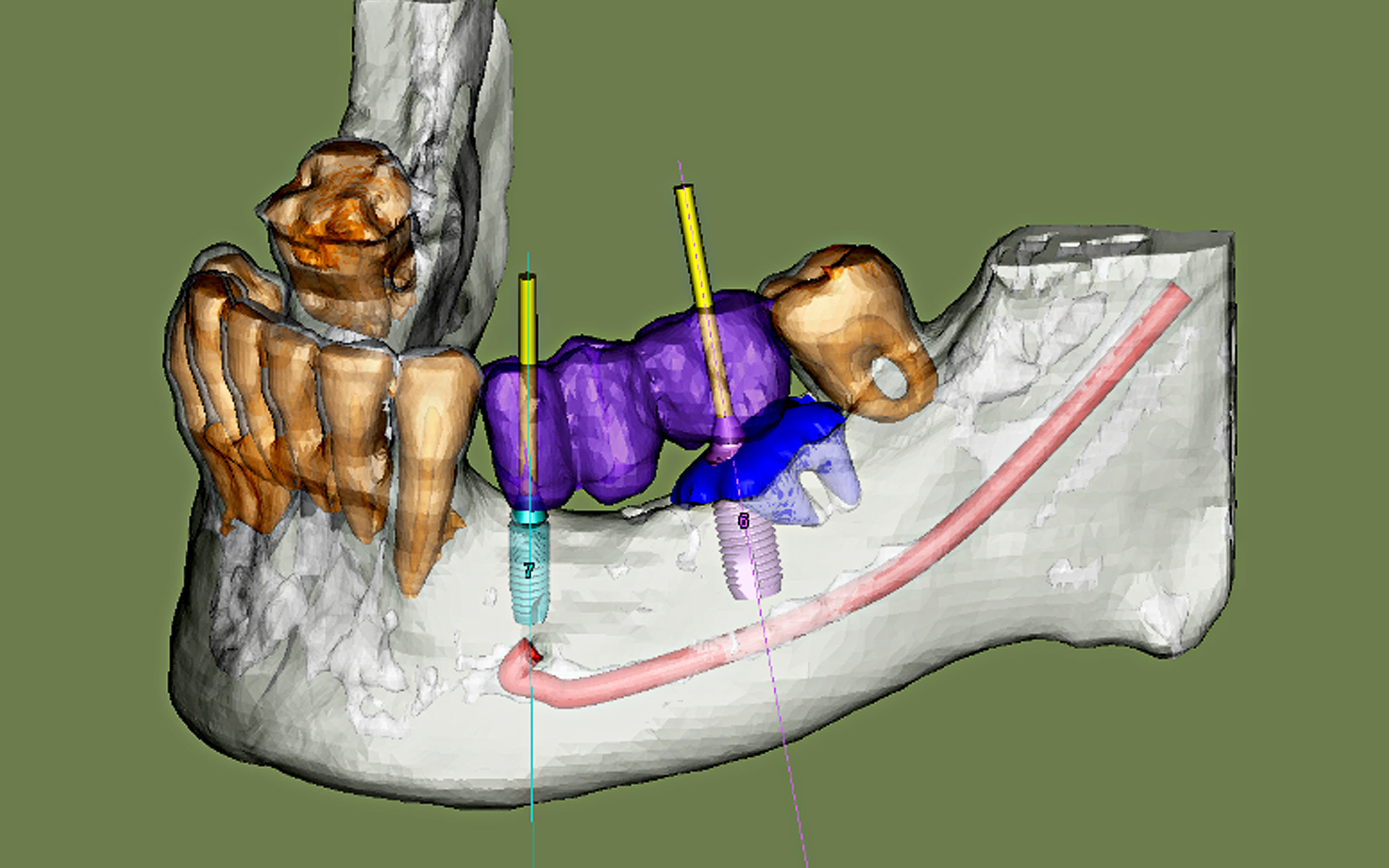
Using dedicated programs, it is now possible to process CT scans for the anatomical and radiological study of the mandibular and maxillary bones. The computer programs the position of the implants and teeth on the three-dimensional model of the bone. This results in a 3D virtual surgical plan, revolutionizing the implantology approach. It is thus possible to rehabilitate a patient with fixed implant-supported prostheses in a single session and with minimally invasiveness.

Dental Implantology in Rome by Dr. Maltese: Computer-aided design.
The patient undergoes a radiological examination to study the bone. This examination is performed wearing a radiological mask, which mimics the position of the patient's teeth in their mouth. The data obtained will be processed in a specific program called Simplant. This is where the doctor begins his navigation, allowing him to virtually perform the procedure on the patient. He places the implants in the position deemed most appropriate based on the residual bone and the anatomical structures to be respected. The plan is sent online to the Materialise Dental headquarters in Belgium. Here, a 3D resin model is created using laser machines, which is an exact reproduction of the patient's bone. A personalized surgical guide called Surgiguide is then built on this model. This allows the implants to be inserted exactly in the position programmed on the computer. The surgeon then transfers all the previously developed information to the clinical reality, simply by appropriately positioning the guide on the patient's bone and following the directions and angles imposed by it with the drills. The same guide is used by the dental technician to construct temporary teeth that will be applied in the same session, joining them to the implants.
 Dental Implantology in Rome by Dr. Maltese: Minimally Invasive and Advanced Age.
The technique reaches its peak in cases where all the teeth in one or both dental arches have been lost. Traditional dentures often force patients to live a difficult life due to the mobility of the prosthesis. In some of these cases, if the bone is abundant, the implants can even be inserted without cutting into the gums, thus minimizing the invasiveness of the procedure. Even single or multiple missing teeth among healthy teeth can benefit from the minimally invasive approach. If the bone is scarce, the case study is so thorough that it improves the quality and effectiveness of more complex procedures. All patients eligible for implantology, including elderly patients and especially those with age-related diseases, coagulation disorders, or metabolic disorders, can be treated, provided they are performed under strict medical supervision. Minimally invasive techniques are the basis of this procedure. Flapless techniques, where applicable, are the solution to many patients' problems.
However, the quality of the study with which it is carried out, the attention to detail, and the depth of the technical evaluation make it a method above the others. Therefore, almost everyone can be treated on an outpatient basis with the computer-guided implant surgery technique.
Dental Implantology in Rome by Dr. Maltese: All the Benefits.
The advantages of this technique for patients are numerous:
– minimally invasiveness is the magic word;
– no scalpel;
– no stitches;
– operating times are halved.
Those who wish can perform the procedure under "conscious sedation." This form of anesthesia renders the patient consciously stunned with retrograde amnesia, so upon awakening, they remember almost nothing of the procedure and no time seems to have passed.

Another advantage is the possibility of performing "immediate loading." This technique is a trend in modern implantology, in which a temporary prosthesis is attached to the newly placed implants. This allows the patient to leave the office with permanent teeth.
This method is amplified when applied to computer-guided surgery, because the temporary restoration is made by the dental technician before the surgery based on the same guide used by the doctor.
In cases where the patient's old complete denture is well-made and preserved, thanks to a particular method, it is even possible to modify it and adapt it to the implants, transforming it from removable to fixed. This means that, by using a reduced number of implants, ranging from 4 to 6, the costs of the entire treatment are also significantly reduced.
Finally, the technique requires a limited number of sessions, and being able to smile again in just one day is an advantage for any patient. The clinician can perform a procedure that has already been thoroughly studied. This provides a greater sense of security, shortens the duration of the procedure, and consequently reduces stress. The surgical guide allows for certainty of the depth, inclination, and position of the implants, thanks to the precision inherent in the technique.