
Immediate loading implantology – all in one day
This method involves the positioning of implants in toothless or toothless areas at the same time as the implant placement and the application of temporary restorations immediately or at most within 36-48 hours of the procedure.
This technique cannot be used routinely, but can only be applied to well-selected cases following very restrictive technical protocols. However, it must be said that all the classic canons of traditional implantology have been overturned, which involve the placement of implants and a wait for bone healing around the implant, which varies between 2 and 6 months depending on the affected site. Only after this healing is it possible to load the implants through chewing.
Clearly, to obtain the desired results and meet the patient's expectations, an in-depth pre-surgical study is essential. This must be performed to evaluate the quality and quantity of available bone, to decide on the type of rehabilitation, to verify its aesthetics and to study other essential parameters for the correct resolution of the case, such as the resistance to screwing of the implant.
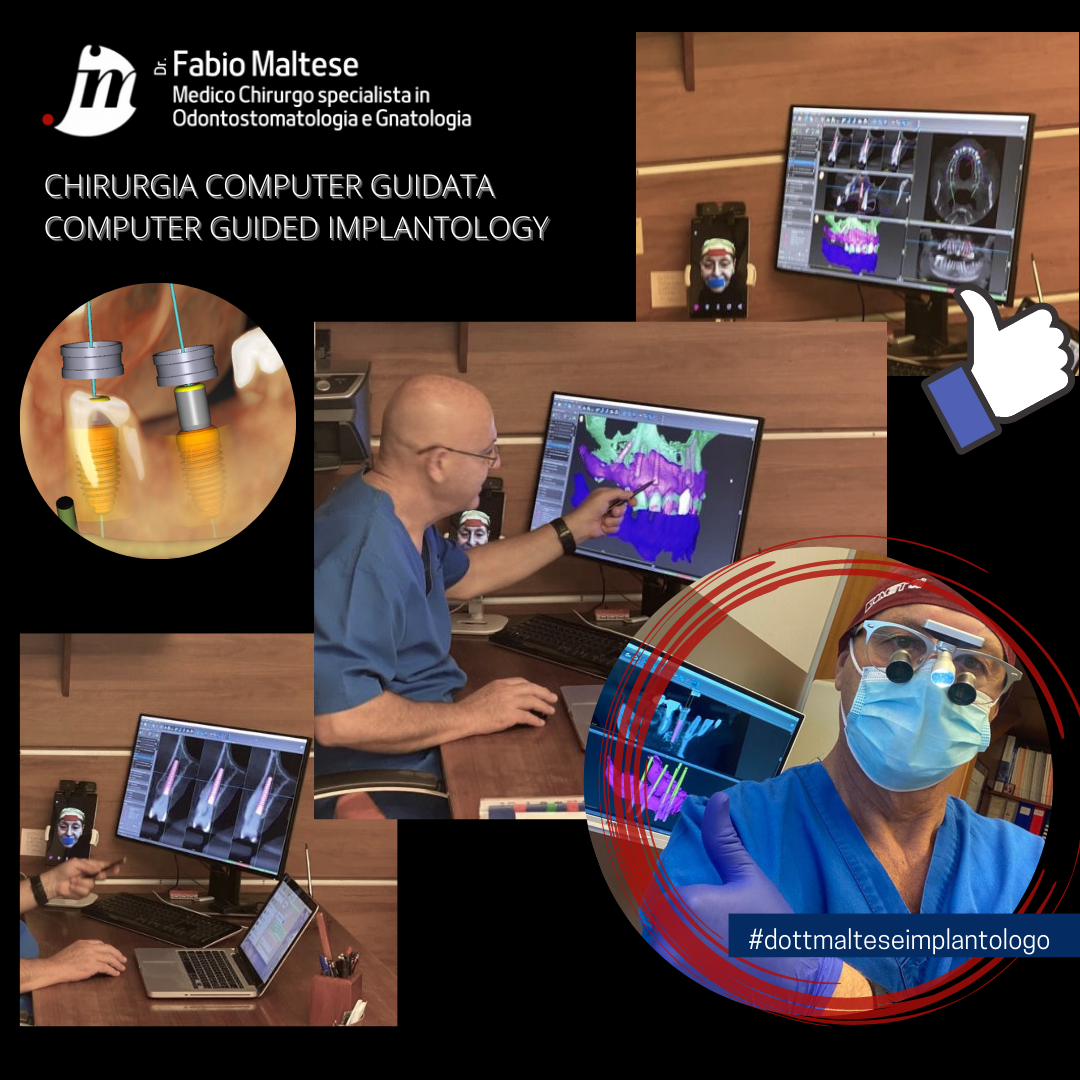
The combination of this technique with Computer-guided implantology maximizes the innovation and quality of the method, since the computer-assisted study is extremely refined and the temporary restoration applied immediately after surgery is produced by the dental technician based on the data acquired in the computerized implant design. Maximizing results is therefore achieved by performing, whenever possible, an implant insertion technique without the use of scalpels and stitches , resulting in minimally invasive surgery and maximum reduction in pain, swelling, and post-surgical bleeding. Combining this with immediate loading on previously produced temporary dentures, which fit perfectly with the inserted implants, the patient can transform their mouth in just one day and leave the office with their own fixed teeth.
Immediate loading implantology, as conceived in this way, resolves complex cases of total edentulism, but can also be applied to cases where a single tooth is missing in aesthetic areas, so that the patient can move from the extraction of a diseased tooth directly to the insertion of an implant and simultaneously of a temporary resin restoration.